 East Lothian Fitted Wardrobes
Fitted Wardrobe Materials and Finishes in East Lothian
The Core Materials You Will Encounter
Most fitted wardrobes in East Lothian are built from one of three board types: moisture-resistant MDF (medium-density fibreboard), melamine-faced chipboard, or solid timber. Each behaves differently, costs differently, and suits different rooms. Understanding what you are buying before a joiner or installer quotes you is the fastest way to avoid overspending or underspecifying.
MDF
MDF is the most widely used carcass and door material in bespoke fitted wardrobes. It machines cleanly, holds paint without grain bleed, and can be routed into detailed profiles. Standard MDF is not suitable for bathrooms or any wall prone to condensation, but moisture-resistant (MR) MDF handles those environments safely. Sheets typically run 15–18 mm thick for carcasses and 18–22 mm for doors.
Melamine-Faced Chipboard
Melamine-faced chipboard (MFC) is chipboard with a thin resin-impregnated paper laminate bonded to both faces. It is lighter and cheaper than MDF, comes pre-finished in dozens of colours and woodgrains, and is the material behind most flat-pack and many trade-fitted wardrobes. The core is less dense, so heavy fixings need careful positioning near edges to avoid pull-out.
Solid Timber
Solid pine, oak, or ash is used mainly for door frames and decorative face frames rather than full carcasses. A fully solid-timber carcass is rare and expensive. Where you do see it, dimensional movement with East Lothian's coastal humidity variations becomes a real design consideration. Skilled joiners account for this by using floating panel construction.
Finishes and How They Look in Practice
The finish is what you actually see and touch every day, so it deserves as much attention as the substrate beneath it.
Painted Finishes
MDF painted in a satin or eggshell finish is the go-to choice for homeowners who want a seamless, furniture-quality look. A skilled sprayer applies several coats in a controlled environment, sands between coats, and delivers a surface that rivals factory-lacquered furniture. Brush-applied paint is slower to build up and tends to show marks more readily. Farrow and Ball, Little Greene, and Dulux Trade ranges are all achievable on MDF; your joiner will usually spray in their workshop rather than on-site to control dust.
Vinyl Wrapping
Vinyl wrapping bonds a flexible PVC film to an MDF or chipboard door. It allows curves and routed profiles to be covered in a single sheet without painting, and it resists moisture well. High-gloss vinyl in particular gives a lacquered appearance at a lower cost than sprayed lacquer. The limitation is that wrapping can lift at corners after several years, particularly in rooms with strong direct sunlight, so south-facing bedrooms in East Lothian properties worth watching.
Real Wood Veneer
Veneer is a thin slice of real timber, typically 0.6–1.5 mm, pressed onto an MDF or plywood substrate. It gives genuine wood grain and texture without solid-timber cost or movement problems. Oak, walnut, and ash are the most requested species locally. Veneer can be stained, oiled, or lacquered, and when done well it is indistinguishable from solid wood at arm's length.
High-Gloss Acrylic and Lacquer
Acrylic panels and sprayed lacquer finishes are chosen when a highly reflective surface is the goal. Acrylic sheet, sometimes called high-gloss board, is a solid-colour panel with a factory-polished face. It shows fingerprints readily and scratches more easily than satin finishes, so it suits lower-traffic wardrobes rather than children's rooms.
Colour and Hardware Choices
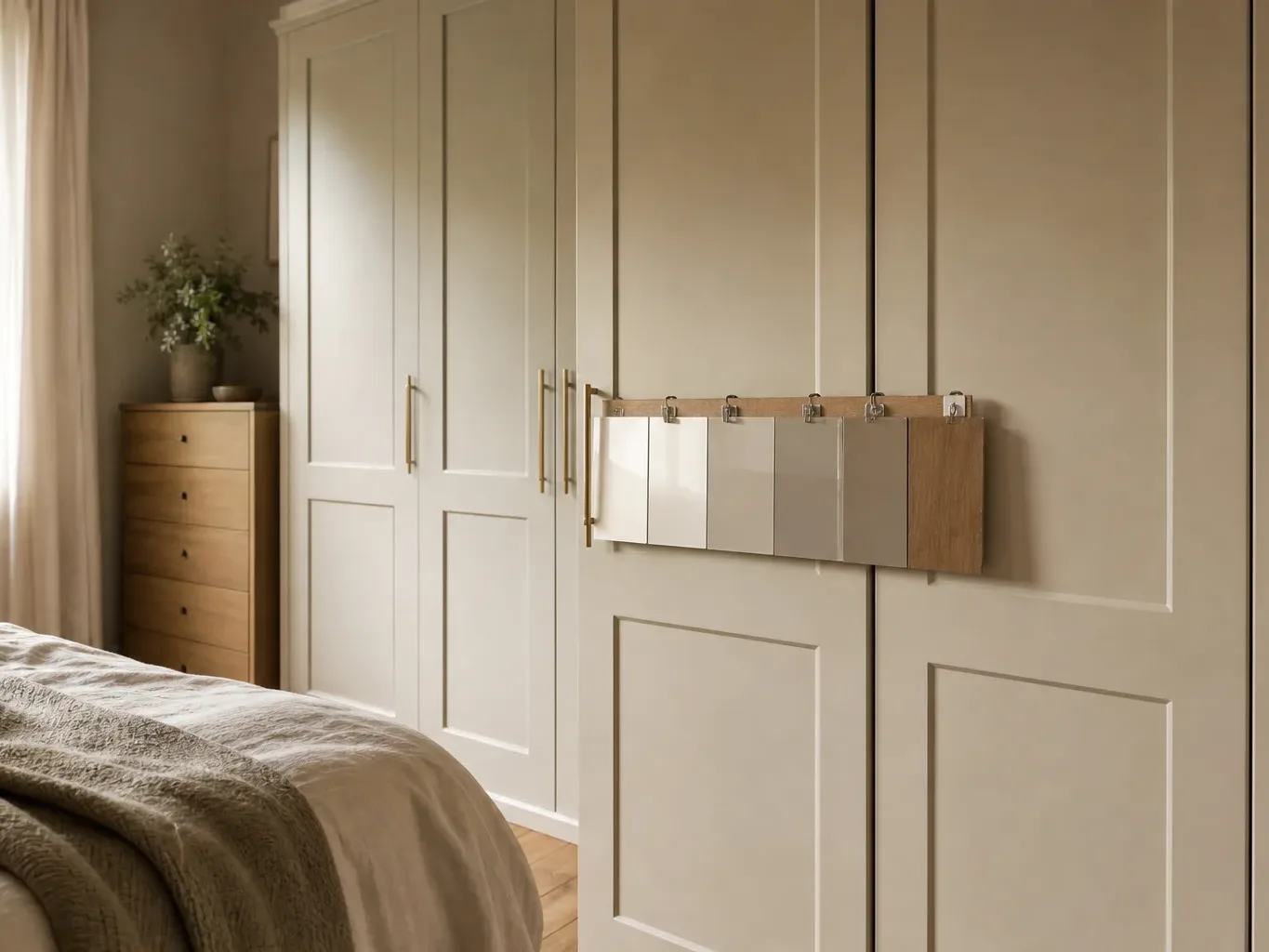
Colour selection has expanded considerably. Neutral whites, warm greys, and deep navies remain the most popular across East Lothian properties, partly because they photograph well for resale and partly because they age without feeling dated. Soft sage greens and dusty pinks have gained ground in the last few years, particularly in period conversions in North Berwick and Haddington.
Handles and hinges affect both aesthetics and usability. Brushed brass and matte black are the dominant hardware finishes right now, replacing the chrome that dominated a decade ago. Handleless designs use a routed finger-pull channel or a push-to-open mechanism, which keeps door faces uninterrupted and suits contemporary interiors. Concealed soft-close hinges are now standard from most quality suppliers and make a noticeable difference to daily use.
How Specification Affects Price in East Lothian
Material and finish choices are the single biggest lever on fitted wardrobe cost, more so than size alone. A 2.4 m run of MFC wardrobes with standard bar handles sits at the lower end of the market, typically in the £1,200–£2,000 range fitted, depending on internal configuration. The same run in painted MDF with soft-close hinges and handleless doors moves into the £2,500–£4,000 bracket. Solid oak veneer with sprayed lacquer and bespoke internal fittings can reach £5,000 or beyond.
Local joiners working from workshops in Musselburgh, Tranent, and Dunbar tend to quote on materials plus labour rather than a system price, so the substrate grade directly appears in your quote. Asking specifically for 18 mm MR MDF rather than standard MDF, or E0-rated boards (the lowest formaldehyde emission class), is a reasonable and achievable request with most East Lothian tradespeople.
Matching Materials to Your Home
Older stone-built properties, common across East Lothian's coastal towns, often have walls that are slightly out of square and prone to periodic damp. MR MDF or plywood carcasses scripted tightly to uneven walls outperform chipboard in these conditions. Newer build properties on estates around Prestonpans and Longniddry tend to have more consistent wall geometry, making flat-pack or semi-bespoke systems more viable.
Internal fittings, such as hanging rails, pull-out drawers, shoe shelving, and trouser racks, are mostly produced in melamine-faced chipboard regardless of what the doors are made from, because that is what standard fittings are manufactured to. If consistency of material matters to you, confirm with your installer whether the internal components will be colour-matched or finished to suit the door specification.
The finish you choose should be realistic for the room's light levels. A dark-painted wardrobe in a north-facing bedroom with one small window will absorb rather than reflect the available light; a lighter veneer or painted finish in the same space keeps the room feeling open. Visiting a supplier's showroom with your phone's camera, and photographing samples in both artificial and natural light, gives you a far more reliable preview than any brochure.
Frequently Asked Questions
What Materials Are Used for Fitted Wardrobes in East Lothian?
The most common materials are moisture-resistant MDF, melamine-faced chipboard (MFC), and real wood veneer on an MDF or plywood substrate. Solid timber is used selectively for door frames or decorative face frames. The finish applied on top, whether paint, vinyl wrap, or lacquer, is a separate choice from the board material underneath.
Which Fitted Wardrobe Materials Are Most Durable in East Lothian?
Moisture-resistant MDF and birch plywood are the most durable choices for East Lothian homes, particularly in older stone-built properties where walls can hold residual damp. MR MDF resists swelling better than standard chipboard when humidity levels vary. Real wood veneer on a stable MDF substrate also performs well long-term, as long as it is finished with a protective lacquer or oil.
How Do Different Fitted Wardrobe Materials Compare for Quality in East Lothian?
Painted MDF offers the best surface quality for a seamless, furniture-grade look and holds its finish well over time. Melamine-faced chipboard is a practical mid-range choice with a wide colour selection but is less resistant to impact damage at edges. Real wood veneer sits at the top for natural appearance and tactile quality, while solid timber is rarely used for full carcasses due to cost and movement in variable humidity conditions.
What Is the Best Material for Fitted Wardrobes in East Lothian Homes?
For most East Lothian bedrooms, 18 mm moisture-resistant MDF with a sprayed painted finish offers the best balance of durability, appearance, and value. It suits both period properties and modern builds, machines cleanly for scribing to uneven walls, and accepts any paint colour without grain showing through. If budget allows, adding real oak or walnut veneer doors on an MDF carcass gives a premium result that holds its appeal over many years.
Do Fitted Wardrobe Materials Affect the Price in East Lothian?
Yes, materials are the primary driver of fitted wardrobe cost. A melamine-faced chipboard installation in a standard 2.4 m run typically costs £1,200–£2,000 fitted, while the same run in painted MDF with soft-close hinges rises to £2,500–£4,000. Veneer or lacquered finishes with bespoke internal fittings can reach £5,000 or more. Local joiners in East Lothian usually quote materials and labour separately, so the board grade chosen directly changes the final price.